How Much Mulch Do I Need? Calculator, Coverage Chart, and Bag Math
How much mulch you need comes down to three numbers: the square footage of your beds, the depth you want, and whether you buy it bagged or in bulk. Enter your measurements and the calculator returns cubic yards, cubic feet, and the number of bags to grab.
Mulch Calculator
Enter your bed size and depth to get cubic yards, cubic feet, and bags.
How the mulch calculation works
Mulch is sold by volume, but your beds are measured in area, so every estimate is really a unit conversion. Measure the length and width of each bed in feet, multiply them for square footage, then apply your depth:
- Cubic feet = square feet × depth in inches ÷ 12
- Cubic yards = cubic feet ÷ 27
- Shortcut = square feet × depth in inches ÷ 324
That 324 figure is just 27 (cubic feet in a yard) multiplied by 12 (inches in a foot), so the one-step formula folds both conversions together. For odd-shaped beds, split the area into rectangles and circles, work out each piece, and add the square footage before you convert.
The amount one cubic yard covers depends entirely on depth:
| Mulch depth | Area covered by 1 cubic yard | 2 cu ft bags to match 1 cubic yard |
|---|---|---|
| 1 inch | 324 sq ft | 13.5 |
| 2 inches | 162 sq ft | 13.5 |
| 3 inches | 108 sq ft | 13.5 |
| 4 inches | 81 sq ft | 13.5 |
A full cubic yard always equals 13.5 bags of the 2 cubic-foot size no matter the depth, because that ratio is about volume, not how thinly you spread it.
Here is what common bed sizes work out to at the two depths most homeowners use. These figures carry no waste margin, so they match the calculator when its waste field is set to 0.
| Bed area | 2 in: cubic yards | 2 in: 2 cu ft bags | 3 in: cubic yards | 3 in: 2 cu ft bags |
|---|---|---|---|---|
| 100 sq ft | 0.62 | 9 | 0.93 | 13 |
| 200 sq ft | 1.23 | 17 | 1.85 | 25 |
| 300 sq ft | 1.85 | 25 | 2.78 | 38 |
| 500 sq ft | 3.09 | 42 | 4.63 | 63 |
| 1,000 sq ft | 6.17 | 84 | 9.26 | 125 |
How deep should mulch be?
Depth is the setting people most often get wrong, and it changes the total more than any other input. General landscape beds do best at 2 to 3 inches, while trees and shrubs can take 3 to 4 inches over the root zone. Shallow-rooted perennials, vegetables, and anything on a slope want just 1 to 2 inches, since a heavy blanket traps too much moisture and smothers new growth. University of Illinois Extension puts the working range at 2 to 4 inches for most plantings.
If you already have mulch down, measure what is there first and top up only to your target depth. Dumping a fresh 3 inches over last year’s 2 inches is how beds quietly climb past the safe range.
How much extra should you order for waste?
Mulch settles and breaks down, so a bed rarely uses the exact math figure. Natural bark loses roughly an inch of depth a year as it decomposes, and some always ends up compacted on paths or lost to wind. Ordering about 10 percent over the calculated amount covers settling and spillage without leaving you with half a pallet in the garage. The calculator’s waste field applies that cushion for you when you need it.
For refreshing an existing bed, do not re-order the full amount. Subtract the depth you already have from your target, and buy mulch for the difference only. A bed holding 1.5 inches that you want back at 3 inches needs enough for 1.5 inches, not 3.
Bagged or bulk: which is cheaper?
Bagged mulch is easy to haul, returnable if unopened, and fine for small beds. Bulk mulch, sold by the cubic yard, runs cheaper per unit once the project grows. One cubic yard equals 13.5 of the standard 2 cubic-foot bags, so at roughly $4 a bag you are paying about $54 a cubic yard, while bulk typically lands around $25 to $45 a cubic yard delivered. The crossover usually arrives near 500 square feet of bed, where the per-yard savings outweigh the delivery fee. Bulk also needs a driveway spot for the drop and a few hours with a wheelbarrow, since one cubic yard is about nine loads.
The over-mulching mistake that kills plants
More mulch is not better. Piling it against trunks in a cone, the so-called mulch volcano, traps moisture against the bark and invites rot and rodents. Once a layer passes about 4 inches it can turn hydrophobic and actually shed water away from the roots. NC State Extension notes that thick layers over four inches often become water-repellent and that over-mulching is a slow killer of trees and shrubs. Keep mulch pulled back 3 to 4 inches from any trunk or stem, and taper it down near the base so nothing touches the bark.
FAQ
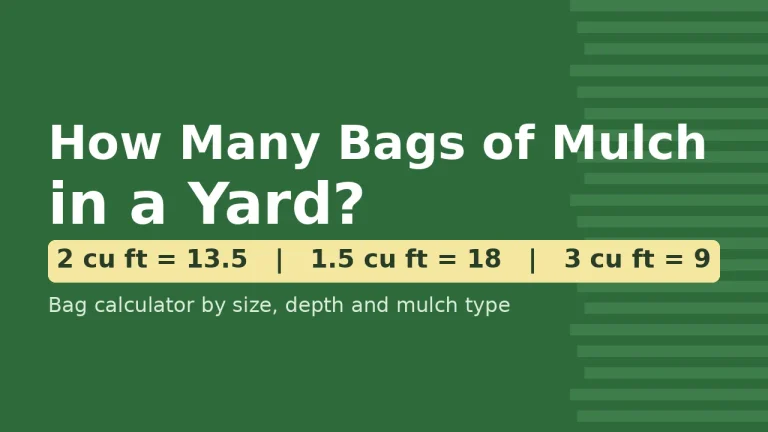
How many bags of mulch are in a cubic yard? A cubic yard is 27 cubic feet, so it equals 13.5 bags of the 2 cubic-foot size, 9 bags of the 3 cubic-foot size, or 18 bags of the 1.5 cubic-foot size.
How much mulch do I need for 1,000 square feet? About 6.2 cubic yards, or 84 bags of 2 cubic feet, at a 2-inch depth. Going to 3 inches raises it to roughly 9.3 cubic yards, or about 125 bags.
Does one cubic yard really cover 100 square feet? Close, at a 3-inch depth it covers about 108 square feet. At 2 inches the same yard stretches to 162 square feet, and at 4 inches it only reaches 81.
Is bagged or bulk mulch cheaper? Bulk wins on price for anything past roughly 500 square feet, but bagged is simpler and avoids a delivery fee on small jobs.
How deep should mulch be around trees? Three to four inches over the root zone, kept well back from the trunk. Never mound it against the bark.
References
- University of Illinois Extension – Proper Mulching Techniques
- NC State Extension – Can Too Much Mulch Kill Plants?