How Much Soil Do You Need to Fill a Raised Garden Bed?
How much soil you need to fill a raised garden bed comes down to one calculation: your bed’s length times width times fill depth, converted into bags or cubic yards.
Raised Bed Soil Calculator
Enter your bed’s inside dimensions to find the soil volume and how many bags to buy.
A cubic yard of bulk soil is 27 cubic feet. Once you need more than about 15 cubic feet, bulk soil by the cubic yard is usually cheaper than bags.
The Formula for Raised Bed Soil
Soil for a raised bed is just a box of volume, so three measurements give you the answer. Measure the inside length, width, and the depth you plan to fill, all in feet, then multiply them together:
Length (ft) x Width (ft) x Depth (ft) = cubic feet of soil
Depth is almost always easier to measure in inches, so divide inches by 12 to convert to feet before multiplying. A fill depth of 10 inches is 0.83 feet.
From cubic feet, two more conversions tell you what to actually buy:
- Cubic yards: divide cubic feet by 27. Bulk soil is sold by the cubic yard, and the University of Illinois Extension uses the same length x width x height method to size a bulk order (Illinois Extension).
- Bags: divide cubic feet by the bag size. Bagged garden and raised-bed mixes are usually sold in 1.5-cubic-foot or 2-cubic-foot bags, so always check the bag before you divide.
Soil Needed for Common Raised Bed Sizes
The table below shows the soil volume for popular bed sizes at a 10-inch fill depth, rounded the way you would actually buy it. Change the depth and your numbers scale up or down in direct proportion.
| Bed size (L x W) | Fill depth | Cubic feet | Cubic yards | Bags (1.5 cu ft) | Bags (2 cu ft) |
|---|---|---|---|---|---|
| 2 x 4 ft | 10 in | 6.67 | 0.25 | 5 | 4 |
| 3 x 6 ft | 10 in | 15.0 | 0.56 | 10 | 8 |
| 4 x 4 ft | 10 in | 13.33 | 0.49 | 9 | 7 |
| 4 x 8 ft | 10 in | 26.67 | 0.99 | 18 | 14 |
| 4 x 12 ft | 10 in | 40.0 | 1.48 | 27 | 20 |
| 5 x 10 ft | 10 in | 41.67 | 1.54 | 28 | 21 |
Bag counts are rounded up to whole bags, because you cannot buy a fraction of a bag and a little extra covers settling.
How Fill Depth Changes the Amount
Fill depth is the single biggest driver of how much soil you buy, and it scales in a straight line. Take a standard 4 x 8 bed and watch the number move:
- 6 inches: 16 cubic feet, about 8 bags of 2-cubic-foot mix
- 10 inches: 26.67 cubic feet, about 14 bags
- 12 inches: 32 cubic feet, about 16 bags
How deep is deep enough? Most vegetables are happy with 6 to 12 inches of loose soil, and 12 inches is a safe all-purpose target. When a bed sits on open, workable ground, the roots can reach down into the native soil below the frame, so you do not always need to fill the full frame height. Oregon State University Extension notes that around 8 inches of mixed soil handles the roots of most vegetables in a bed built over loosened ground. Beds on concrete, pavers, or gravel have no soil underneath, so those need the full rooting depth built into the fill.
Bags or Bulk: Which Is Cheaper
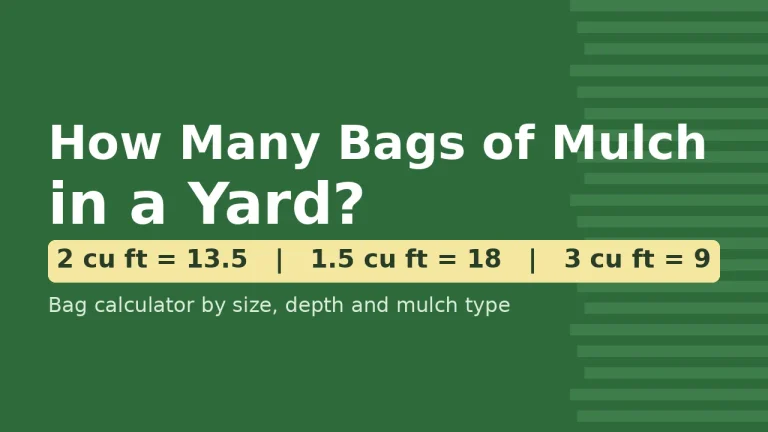
For a small bed, bags win on convenience. For a big one, bulk wins on price. The crossover is easy to spot once you know that one cubic yard equals 27 cubic feet — the same as roughly 14 bags of 2-cubic-foot mix or 18 bags of 1.5-cubic-foot mix.
A single 4 x 8 bed filled 10 inches deep already needs about a full cubic yard. Past roughly 15 cubic feet, bulk soil delivered by the cubic yard is usually cheaper per unit than bags, and it spares you from stacking, hauling, and splitting open two dozen bags. The trade-off is that bulk is sold in whole or half cubic yards and arrives as a pile you have to move, so for one small bed the leftover and the delivery fee can erase the savings.
What to Fill a Raised Bed With
Volume tells you how much; the mix tells you what. The most common failure is filling a raised bed with straight bagged “topsoil” or native garden soil, which compacts into a dense, poorly draining block.
A reliable starting blend is about 70% topsoil and 30% compost, the ratio recommended by Iowa State University Extension, which also offers an alternative of equal parts topsoil, organic matter, and coarse sand (Iowa State Extension). University of Maryland Extension frames the target as 20% to 50% organic matter by volume, and suggests working in at least two inches of compost if you start with plain topsoil (Maryland Extension). For intensive square-foot planting, the classic “Mel’s Mix” is one-third compost, one-third peat or coconut coir, and one-third coarse vermiculite.
Whatever blend you choose, buy the components in the same cubic-foot or cubic-yard volume the calculator gives you, then blend to your ratio.
Save Money on a Deep Bed
You do not have to fill a tall bed entirely with purchased mix. Deep beds get expensive fast, which is why extension guides point out that filling raised beds is one of the larger costs of the project. If your bed is taller than about 12 inches, fill the bottom portion with cheaper bulk material — coarse compost, aged wood chips, or leaves — and reserve the quality mix for the top 8 to 12 inches where roots actually live. Only count the quality-mix depth when you run the calculator for that top layer.
Plan for settling, too. Fresh soil and compost pack down after the first few waterings, so a freshly filled bed will drop an inch or more. Fill slightly proud of the rim, then top it off once it settles rather than buying extra bags up front.
Common Mistakes
- Forgetting settling. New beds sink an inch or two in the first season. Round bags up and keep a bag in reserve.
- Measuring the frame instead of the fill. If you only fill the top 10 inches of a 16-inch bed, calculate for 10 inches, not 16.
- Ignoring the ground below. A bed on open soil borrows rooting depth from the earth beneath it; a bed on a hard surface does not.
- Mixing up bag sizes. A 1.5-cubic-foot bag and a 2-cubic-foot bag look similar on the shelf but change your bag count by a third.
Frequently Asked Questions
How much soil do I need for a 4 x 8 raised bed? At a 10-inch fill depth, a 4 x 8 bed needs about 26.67 cubic feet — roughly 14 bags of 2-cubic-foot mix, 18 bags of 1.5-cubic-foot mix, or just under one cubic yard of bulk soil.
How many bags of soil for a 4 x 4 bed? A 4 x 4 bed at 10 inches deep needs about 13.33 cubic feet, which is 7 bags of 2-cubic-foot mix or 9 bags of 1.5-cubic-foot mix.
How many bags of soil are in a cubic yard? One cubic yard is 27 cubic feet, so it equals about 14 bags of 2-cubic-foot mix or 18 bags of 1.5-cubic-foot mix.
Can I just use regular garden soil or bagged topsoil? Not on its own. Native garden soil and plain topsoil compact and drain poorly in a raised bed. Blend topsoil with compost to roughly a 70/30 ratio, or use a product labeled as a raised-bed mix.
How much soil for a 2 x 4 raised bed? A 2 x 4 bed at 10 inches deep needs about 6.67 cubic feet — 4 bags of 2-cubic-foot mix or 5 bags of 1.5-cubic-foot mix.
References
- University of Illinois Extension — Raised Bed Gardening: https://extension.illinois.edu/sites/default/files/raised_bed_gardening_infosheet_07102023.pdf
- Iowa State University Extension — Soil Mix for a Raised Bed: https://yardandgarden.extension.iastate.edu/faq/what-would-be-good-soil-mix-raised-bed
- University of Maryland Extension — Soil for Raised Beds: https://marylandgrows.umd.edu/2019/02/08/qa-what-kind-of-soil-should-i-use-in-raised-beds/